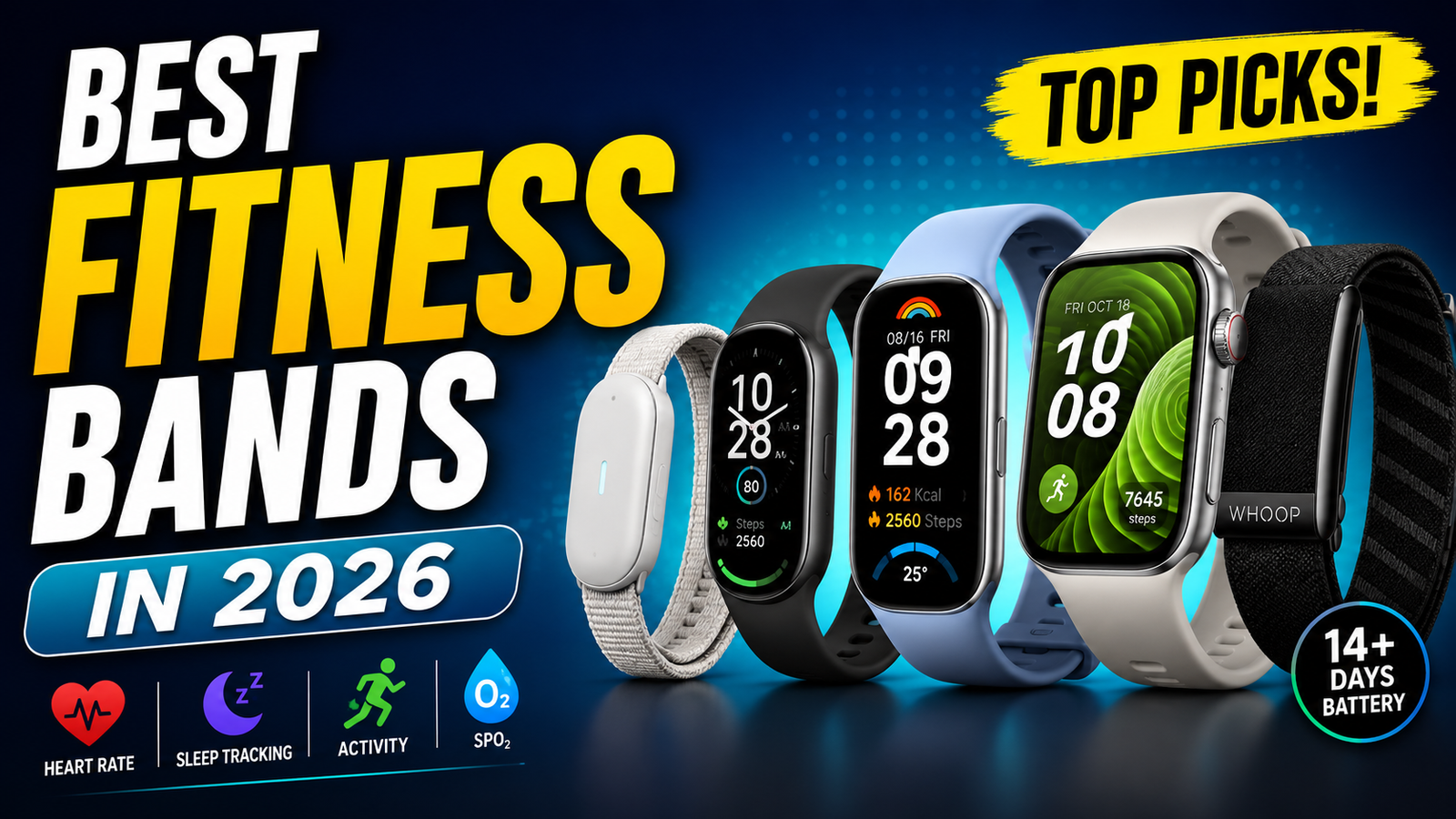
Fitness trackers have become much more capable than simple step counters. Modern bands can monitor activity, heart rate, sleep patterns, blood oxygen levels and other wellness metrics, while some models are designed specifically around recovery and long-term health trends.
The right choice depends on what you actually need from a wearable. A lightweight screen-free band may suit someone who wants discreet 24/7 tracking, while a display-based tracker can be more useful for workouts and everyday activity. Subscription costs, battery life and GPS support are also worth considering before buying.
Here are some notable fitness bands and health-focused wearables to consider in 2026.
Also read: Realme C100i 4G: Leaked Box Details Reveal What to Expect
Google Fitbit Air
Google Fitbit Air is aimed at users who prefer a small, screen-free wearable. Google describes it as a device designed for continuous health and fitness tracking, with a battery rated for up to seven days. The tracker starts at $99.99 in the US. (Google Store)
Its features include heart-rate monitoring, sleep tracking, activity information and other health-related measurements. Google also offers additional coaching and insights through its paid Google Health Premium service. (blog.google)
Best for: Users who want a lightweight, screen-free tracker with Fitbit’s health ecosystem.
Battery: Up to 7 days
Starting price: $99.99
Hume Band 2.0
For people more interested in health trends than notifications, the Hume Band 2.0 takes a different approach. It has no traditional display and is designed to be worn continuously while data is viewed through the Hume Health app.
The company says the band tracks metrics including heart rate, HRV, SpO₂, sleep stages, activity, strain, recovery and skin temperature. It also provides Blood Pressure Insights as trend information rather than a medical diagnosis. (Hume Health)
Battery life is rated at up to 14 days, and core data is available through the Hume app without a mandatory subscription. An optional premium tier provides additional AI-powered coaching and feedback. (Hume Health)
Best for: Long-term wellness and recovery tracking without a screen.
Battery: Up to 14 days
Price: Around $249, depending on the current offer and market
Xiaomi Smart Band 11 Active
If affordability and battery life are high on your list, the Xiaomi Smart Band 11 Active is a practical option.
The tracker has a 1.47-inch TFT display, supports 50 fitness modes, and offers features such as heart-rate monitoring, SpO₂ tracking, sleep monitoring and stress tracking. Xiaomi rates its battery for up to 21 days with light use. (Xiaomi Australia)
It also has 5ATM water resistance, making it suitable for swimming and everyday use, although the company’s health-tracking features are intended for wellness and personal reference rather than medical diagnosis. (Xiaomi Australia)
Best for: Beginners and budget-conscious users.
Battery: Up to 21 days with light use
Display: 1.47-inch TFT
Xiaomi Smart Band 10 Pro
The Xiaomi Smart Band 10 Pro is a step up for users who want a larger and brighter display along with more advanced outdoor tracking.
It features a 1.74-inch AMOLED display with peak brightness of up to 2,000 nits. Xiaomi also lists independent GNSS support with five-satellite positioning systems, which can help with outdoor workout tracking without relying entirely on a phone. (Xiaomi Australia)
Battery life is rated at up to 21 days with light use, while normal usage is rated at around 15 days. (Xiaomi Australia)
Best for: Users who want GPS-style outdoor tracking and a larger display without moving to a full smartwatch.
Battery: Up to 21 days with light use
Display: 1.74-inch AMOLED
GPS: Built-in GNSS
Huawei Watch Fit 5 Pro
The HUAWEI WATCH FIT 5 Pro sits closer to a smartwatch than a conventional fitness band. It combines a large display with health and workout features in a relatively slim design.
Huawei lists a 1.92-inch AMOLED display, 3000-nit peak brightness and sapphire glass protection. The wearable also offers advanced health tracking and outdoor-focused features. (Huawei Consumer)
Because of its larger screen and broader functionality, it may be a better fit for people who want their wearable to do more than quietly collect health data.
Best for: Users looking for a fitness-focused wearable with smartwatch-style features.
Display: 1.92-inch AMOLED
Peak brightness: Up to 3,000 nits
WHOOP 5.0
WHOOP 5.0 is designed primarily around sleep, strain and recovery rather than acting like a traditional smartwatch. Its screen-free design puts the focus on collecting biometric information and presenting it through the WHOOP app.
WHOOP says the 5.0 offers 14+ days of battery life. Its membership options currently include WHOOP One at $199 per year, Peak at $239 per year, and Life at $359 per year. (WHOOP)
The higher Life tier adds features including blood-pressure insights and heart-screening capabilities such as ECG and irregular-heart-rhythm notifications, although availability of some medically regulated features can vary by region. (Whoop Support)
Best for: Athletes and fitness-focused users who want detailed sleep, strain and recovery insights.
Battery: 14+ days
Membership: From $199/year
Fitness Tracker Comparison
| Model | Best suited for | Battery rating | Key highlight |
|---|---|---|---|
| Google Fitbit Air | Screen-free everyday tracking | Up to 7 days | Lightweight design |
| Hume Band 2.0 | Wellness and recovery trends | Up to 14 days | Screen-free health tracking |
| Xiaomi Smart Band 11 Active | Budget buyers | Up to 21 days* | 50 fitness modes |
| Xiaomi Smart Band 10 Pro | Outdoor fitness | Up to 21 days* | Built-in GNSS |
| Huawei Watch Fit 5 Pro | Fitness + smartwatch features | — | Large AMOLED display |
| WHOOP 5.0 | Recovery and performance | 14+ days | Sleep and recovery focus |
*Battery estimates depend on usage conditions.
Which One Makes the Most Sense for You?
There isn’t one fitness tracker that is ideal for everyone.
If you want something small and screen-free, Fitbit Air or Hume Band 2.0 may be worth considering. The Hume option puts more emphasis on long-term wellness data, while Fitbit offers a broader established fitness ecosystem.
For a lower-cost tracker with long battery life, Xiaomi’s Smart Band 11 Active is an attractive choice. If built-in outdoor positioning and a brighter, larger screen are more important, the Smart Band 10 Pro is the more advanced option.
The Huawei Watch Fit 5 Pro makes more sense if you want a wearable that feels closer to a smartwatch, while WHOOP 5.0 is particularly focused on recovery, sleep and training insights.
What to Check Before Buying
Before choosing a fitness band, don’t look only at the number of health features. Consider how you’ll actually use the device.
Check the following:
- Battery life: Longer battery life means less frequent charging.
- Display: A screen is useful for checking workouts and notifications, while screen-free designs can be less distracting.
- GPS/GNSS: Important if you regularly track outdoor walks, runs or cycling.
- Sleep tracking: Useful if sleep monitoring is one of your main priorities.
- Water resistance: Check the manufacturer’s rating if you plan to swim with the device.
- App compatibility: Make sure the wearable works properly with your smartphone.
- Subscription fees: Some platforms keep advanced insights behind a paid membership.
- Health features: Treat wearable measurements as wellness information unless a feature is specifically approved for medical use.
Final Verdict
The best fitness band in 2026 depends more on your priorities than on the number of features listed on the box. Screen-free trackers such as Google Fitbit Air and Hume Band 2.0 are suited to people who want discreet, continuous tracking, while Xiaomi’s bands focus on affordability, battery life and everyday fitness.
For a larger display and more smartwatch-style functionality, the Huawei Watch Fit 5 Pro offers a different experience. Meanwhile, WHOOP 5.0 is aimed at users who place particular importance on sleep, recovery and training data.
Before buying, compare the device’s battery life, tracking capabilities, smartphone compatibility and any recurring subscription costs. Most importantly, choose a tracker that fits naturally into your daily routine rather than paying for features you are unlikely to use.